












Ready to Quit Smoking?
Quitting smoking isn’t easy but it can be done with the support of friends, family, and your doctor.
Many of you are thinking, “I know, here comes another lecture on why I should stop smoking!”. However, the fact that you are reading this blog means that you are seriously interested either subconsciously or consciously. Obviously, quitting smoking has significant health benefits as well as social benefits. It is no longer accepted social norm to smoke. In the past, it used to be not only socially acceptable, but “cool” to smoke. Today however, smokers are ostracized and frowned upon. Here are some benefits of quitting smoking:
- Blood Pressure will decrease and your heart will thank you.
- Improve lung function. In fact, oxygen delivered to your body improves within 24 hours of stopping smoking.
- Decrease lung cancer risk.
- Decrease second hand lung cancer risk.
- Financial rewards: smoking is an expensive habit that keeps on growing.
- More personal and professional productivity: You will get more things done because you are not taking smoking breaks.
- Better concentration and cognition.
- Better health and wellness.
- Better breath.
- More social acceptance.
These are a few advantages to consider quitting.
But how does one go about quitting? Smoking is not only an addiction to nicotine but also behavioral issue deeply ingrained as part of one’s life style. Not only does a smoker have to get over the physical addiction, he must also overcome behavioral habit that has been deeply wired into his or her psyche.
Quitting is not easy but it can be done. What is very important is to have a plan as well as a rock solid support system and personal commitment.
Here is the recommended steps to help facilitate the process of smoking cessation.
Start Date
Everyone needs to set a quit date. You can do this by yourself. Mark it on your calendar.
Visit Your Family Physician (Doctor) or Nurse Practitioner
Your personal physician will be able to help you start. This affirms concretely that you are ready to quit your nasty habit. Your physician will go over a series of questions and help you to initiate this process and recommend aides such as over-the-counter nicotine gum or patches. If you have been a heavy smoker for longer than 10 years, your physician may provide a prescription such as Chantix or anti-depressants to help facilitate your goal.
Announce Your Intentions and Commitment
Tell your friends, neighbors, co-workers, family members, your health care provider, or for that matter, anyone that will listen, to gain support and positive reinforcement. The goal here is to gain support because a positive and nurturing environment will be conducive to success.
Don’t Try to Quit Cold Turkey
There are very few people who can withstand the “cold turkey” method. A sensible way is to stop buying additional cigrettes and gradually reduce smoking. A good rule of thumb is to follow the “minus one rule”. The goal is to count how many cigarettes you smoke each day and each subsequent day reduce by one. Once you get to zero, do not buy any more cigarettes.
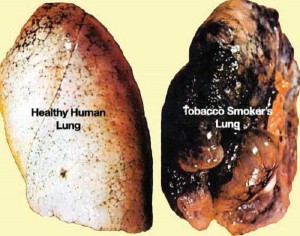
Healthy lung vs. lung cancer due to smoking.
Make a Visual Reminder System and Reward System
This could be a vacation as a result of your success, pictures of your young children, or if all else fails, a negative reinforcer such as this picture to the left. Actually, the cancer ridden black lung of a deceased smoker is the best reminder as to why you want to quit and why YOU HAVE TO QUIT. The fact is, your lungs are already black from smoking. While it is true that there are some who smoke all their lives and not get lung cancer, the odds are not in your favor. This is like making an analogy that just because you can make a basket once in a while playing basketball, that you are going to become Michael Jordan. It just doesn’t happen that way.
Keep a Daily Journal
In the end, you are only accountable to yourself. In order to do this, you need to keep a journal that will include the following: Date, Time of each cigarette used, Description of why you smoked each cigarette, how it made you feel physically, and your mood each day. When you wake, you will also describe how you feel mentally and physically. Read the journal every day from beginning to end each day.
Start Exercise Routine and Supplements
Begin taking 20 to 25 minute walks, especially if you have not been physically active. Additionally, ask your provider about getting on a good multi-vitamin for supplements. Smoking cigarettes and then stopping will require more micro-nutrients. Starting this healthy habit will lead into better eating habits.
This isn’t meant to be an exhaustive answer to smoking cessation. It is merely a start guide. There are different triggers both social and emotional that cause people to smoke. Some are complex while others are simple to overcome. There will be nicotine withdrawl symptoms and this is why quitting cold turkey is not recommended. While the path to cigarette free liferstyle will not be easy, there are many who succeed. It all depends on how you approach the quitting process. At Camelback Health Care, we believe that the steps outlined above will ensure that you have the BEST CHANCE for success.
Here are some helpful links to further aid you in quitting:
Centers for Disease Control and Prevention
Good luck! We are on your side. You can do it! Congratulations on your first step towards smoke free life.


